

From Empire to Internet, How English Took Over the World

By Angelica Praxides · Published
Angelica is a book lover who thrives in quiet libraries, enjoys good coffee, and chases something new to learn every day.
You can step off a plane in a place you have never visited before, look at airport signs or your phone screen, and still see words you recognise. English is on tickets, forms, menus, and websites. For many people alive today, it already feels normal, almost invisible, like background noise.
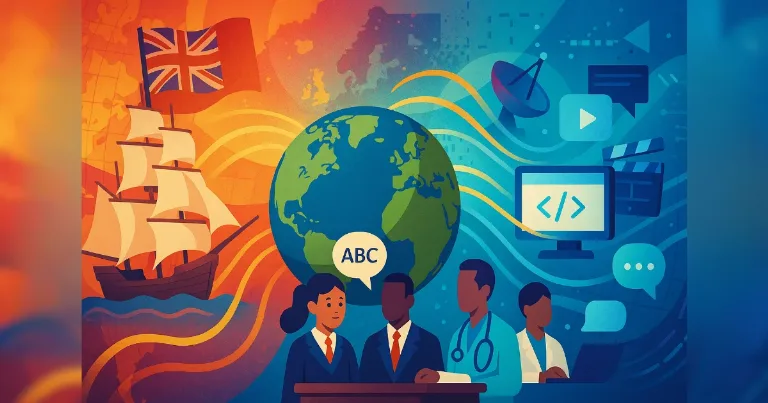
But this did not happen because English is nicer, clearer, or more logical than other languages. It spread mainly because of history and power, for example:
-
Empire and colonisation, British control of trade routes and colonies carried English into schools, courts, and offices.
-
Economic and military power, first Britain and later the United States used English in global trade, diplomacy, and agreements.
-
Science, business, and technology, many international companies, journals, and standards chose English as their working language.
-
Media and internet, films, music, games, and early websites made English the default sound and text of global culture.
Power moved around the map, and English travelled with it.
Ships, flags, and classrooms
For a long time, the British Empire controlled trade routes, ports, and whole regions far from Europe. Officials needed one working language for law, taxes, and orders, so they carried English into schools, courts, and offices.
Local children were often taught in English if they wanted a government job or a place in the new schools. People did not just pick English for fun, they needed it to move up, to get paid, or simply to avoid trouble.
In many colonies, there were already many languages inside one border. Choosing a single local language could look like giving one group more power than the others. English often became the outside option, nobody's mother tongue for most people, but the language of paperwork and meetings.
By the time empire flags came down, English was already tied to law, business, and higher education. Keeping it was the easiest way to keep the system running, even as local languages slowly returned to public life.
Superpower, pop culture, and the internet
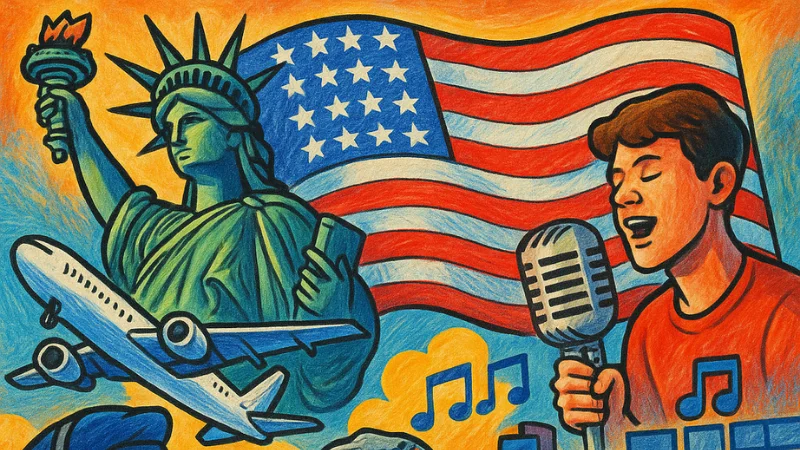
After the world wars, the main centre of global power shifted again, this time to the United States. English stayed on top, but now it was pushed less by soldiers and more by money, science, and media.
Many big companies that traded across borders used English inside their offices. Pilots and air traffic control needed a shared language in the sky, so aviation rules settled on English. Research labs and universities that shaped new technology published more and more in English too.
Then came the cultural wave. Hollywood films, pop music, TV shows, and later video games reached people who never had contact with British rule. You could sing along to songs and quote lines from movies long before you felt able to hold a full conversation, but the sound of English was already familiar.
When computers and the early internet spread, a lot of the key code words, standards, and first websites were built in English. That does not mean other languages were shut out, but the first layer of the digital world came with English labels. New users learned those words because they needed them to log in, search, or write an email.
Put all this together and you get a strong push in one direction. Empire started the job, a superpower economy and global media kept it going, and the internet locked it in as the default choice when two strangers need common ground.
Today, a shared tool with a heavy history
Right now, English is still not the biggest native language on earth, but it is the most common second or third language. Many people learn it at school not because they love it more than their own words, but because it opens doors in travel, work, and study.
Take the Philippines as one example. Filipino, based on Tagalog, is the national language and people use many other local languages at home, but English still sits in important places such as government, higher education, and a lot of business in big cities like Metro Manila. So students grow up switching between languages, using English for exams, interviews, and formal documents, even though their deepest stories are often told in their own local tongues.
In practice, English is used as a meeting point. Two students from different continents work on a project, and they type in English. A doctor reads a new medical paper, and it is written in English. A developer checks a software manual, and the examples are in English again. The language makes contact possible, even when no one in the room grew up speaking it first.
There is a cost, of course. People can feel pressure to sound like a native speaker to be taken seriously. Some communities see their local languages lose space at school or at work. English can carry the weight of old empires and current power gaps, not just neutral words.
At the same time, millions of speakers have started shaping English in their own way. New accents, local phrases, and mixed forms of speech show that the language now belongs to far more people than those from its original islands.
So when you hear English on the street or read it on a screen, you are seeing the result of centuries of force, habit, and choice stacked on top of each other. From empire to internet, the world did not agree on English because it was the fairest option. It simply became the most useful tool at the points where trading vessels docked, deals were signed, and later, where cables carried light under the sea.